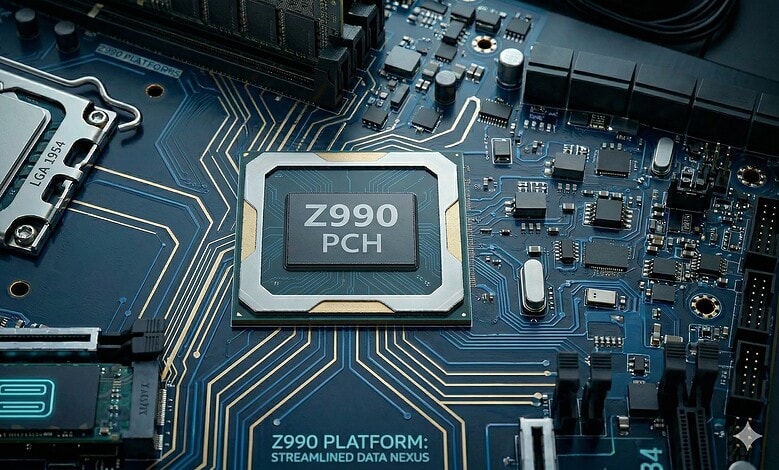
As we move through 2026, the PC hardware landscape is bracing for one of the most significant architectural shifts in a decade. While the “Arrow Lake Plus” (Core Ultra 200 Plus) series is currently dominating the enthusiast market, all eyes are now on the leaked successor: the Intel Z990 chipset.
And to be honest it is about time. I am slowly getting sick of reviewing the same CHIPSETS for the past 2 years now. I need, you need, we all need something new.
Designed to accompany the “Nova Lake-S” (likely the Core Ultra 400 series) processors, the Z990 isn’t just a minor iteration. It represents a total reimagining of the desktop platform, moving to a new socket, introducing native high-speed connectivity, and managing power demands that were once reserved for high-end workstations.
1. The Foundation: Socket LGA 1954 and “Nova Point”
The biggest news for builders is the introduction of the LGA 1954 socket. Following Intel’s relatively short-lived LGA 1851 platform, the shift to LGA 1954 is necessitated by the massive increase in I/O and power delivery required by Nova Lake CPUs.
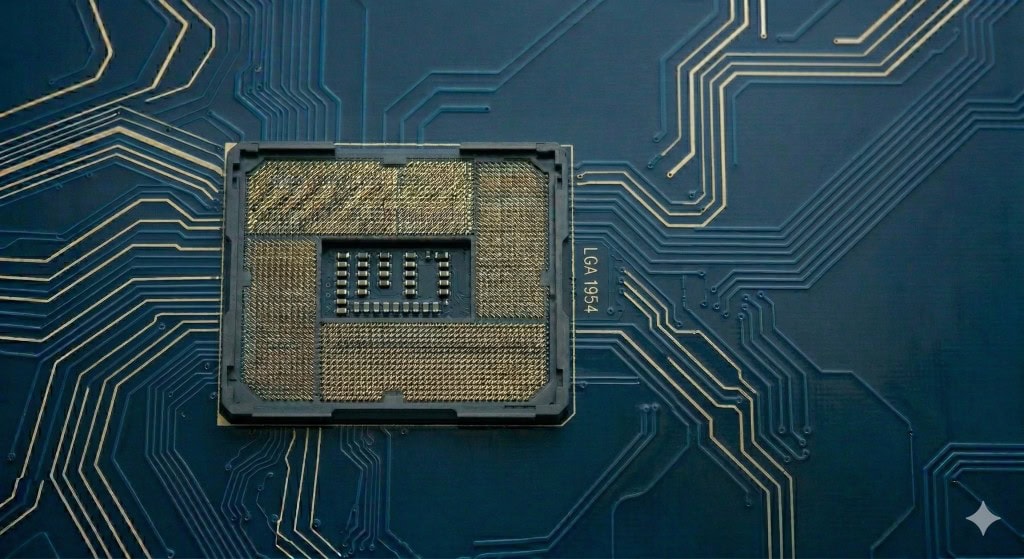
Internally codenamed “Nova Point,” the 900-series chipset family (which includes the Z990, Z970, and B960) moves to a new communication protocol. The Z990 will utilize a DMI Gen 5 x4 link. While the lane count is lower than previous generations, the move to PCIe 5.0 speeds doubles the bandwidth per lane, providing a massive 128 Gbps “highway” between the CPU and the chipset. This ensures that even with multiple high-speed peripherals connected, the system won’t face the data bottlenecks that occasionally plagued older platforms.
2. Connectivity: A PCIe 5.0 Revolution
For years, the “PCIe 5.0” label on motherboards was a bit of a marketing trick—the high-speed lanes usually came directly from the CPU, while the chipset itself lagged at PCIe 4.0 or even 3.0. The Z990 changes the game entirely.
-
Total PCIe Lanes: The platform reportedly supports a staggering 48 lanes.
-
Chipset-Native PCIe 5.0: In a first for Intel, the Z990 chipset itself provides 12 dedicated PCIe 5.0 lanes. This allows motherboard manufacturers to include multiple Gen 5 NVMe SSD slots without “stealing” bandwidth from the primary GPU slot.
-
Thunderbolt 5 / USB4: The Z990 is designed to fully exploit the CPU’s integrated Thunderbolt 5 controller, supporting dual ports with speeds up to 120 Gbps (using Bandwidth Boost) or a symmetrical 80 Gbps.
3. The Great Segmentation: Z990 vs. Z970
In a move that mirrors AMD’s recent motherboard strategy, Intel is reportedly splitting the high-end into two tiers: the Z990 and the Z970.
Intel 900-Series vs. 800-Series Chipset Comparison
The Z990 is the “no-compromise” board. It is the only consumer chipset that will support Base Clock (BCLK) overclocking, a feature critical for competitive overclockers and those looking to squeeze every drop of performance out of non-K series chips (though it’s usually paired with the best CPUs anyway). The Z970, meanwhile, offers a more affordable entry point into the “Z” class, retaining multiplier and memory overclocking but cutting back on the high-speed PCIe 5.0 lanes provided by the chipset.
4. Power Delivery: The 700W Frontier
Perhaps the most shocking revelation from the recent leaks is the power profile of the flagship Nova Lake-S processors. High-end variants, featuring up to 52 cores (a combination of P-cores, E-cores, and the new LP-E “Low Power Island” cores), are rumored to have a PL4 (Peak Power) state of over 700W.
While “average” gaming power consumption will be much lower, the Z990 motherboards must be built to handle these massive transient spikes. This means we can expect:
-
Heavily Reinforced VRMs: Motherboards with 24+ phase power designs will likely become the standard for the Z990 tier.
-
Enhanced Cooling: We may see a return to active cooling (fans) on chipset heatsinks and VRM blocks to manage the thermal output of the high-speed PCIe 5.0 controllers.
-
Power Connectors: Expect to see dual or even triple 8-pin CPU power connectors as a requirement, rather than an option.
5. Memory and Cache: The “bLLC” Factor
The Z990 platform will be the first to natively support DDR5-8000 memory across all slots, a significant jump from the native DDR5-6400 of the previous generation.
Furthermore, the chipset is designed to work in tandem with Intel’s new “bLLC” (Big Last Level Cache). Leaks suggest flagship Nova Lake CPUs will pack up to 144MB to 288MB of cache, a direct response to AMD’s X3D technology. The Z990 BIOS will play a crucial role in managing how this cache is utilized by the OS, particularly in gaming scenarios where latency is king.
Timeline: Intel is expected to officially unveil the Z990 and Nova Lake-S lineup at CES 2027, with a “paper launch” or limited enthusiast release possible in late 2026.