The landscape of PC gaming has always been defined by a relentless pursuit of “The Holy Grail”—photorealistic graphics rendered in real-time at interactive frame rates. For decades, we chased this goal through brute-force hardware power: more transistors, higher clock speeds, and massive power draws. However, at GTC 2026, NVIDIA officially declared the end of the “brute force” era. With the unveiling of DLSS 5 (Deep Learning Super Sampling 5), the company has pivoted entirely toward a future where pixels are no longer calculated by a game engine, but predicted by a neural network.
If DLSS 2 was about clarity and DLSS 3 was about fluidity, DLSS 5 is about existence. It is the most significant leap in computer graphics since the introduction of hardware-accelerated Ray Tracing in 2018. But as the line between “rendered” and “generated” blurs, it brings with it a storm of technical awe and artistic controversy.
The Architecture: From Reconstruction to Generation
To understand why DLSS 5 is a “GPT moment” for gaming, we have to look at how it differs from its predecessors. Previous iterations were essentially sophisticated filters. They took a low-resolution frame, looked at the “jitter” of pixels over time, and used AI to guess what a high-resolution version should look like.
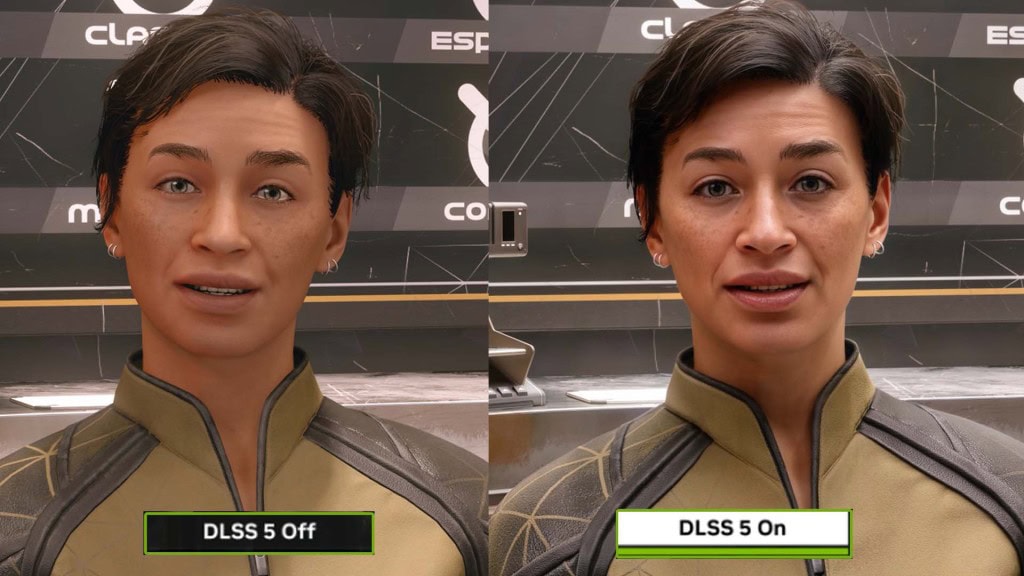
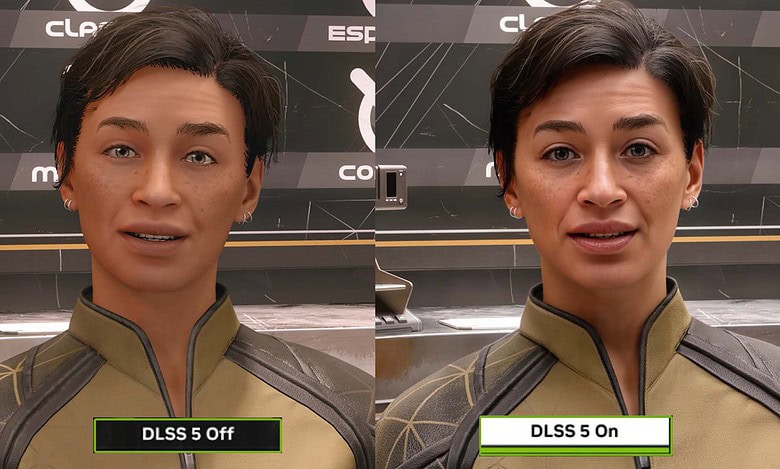
DLSS 5 discards the “guesswork” for Neural Material Reconstruction. Using the massive leap in Tensor Core throughput found in the new Blackwell (RTX 50-Series) architecture, DLSS 5 uses a generative model trained on millions of hours of path-traced offline renders. When you play a game, the GPU doesn’t just see a collection of polygons and textures; it “recognizes” the scene. It understands that a specific cluster of pixels represents human skin, while another represents brushed aluminum.

Instead of just upscaling the texture, DLSS 5 re-draws the material properties in real-time. It injects “Neural Micro-Details”—pores on skin, fine scratches on metal, or the complex scattering of light through a glass of water—that don’t actually exist in the game’s original assets. The result is a game that looks higher-fidelity than the developers actually built.
Comparison: DLSS 3.5 vs. DLSS 5
To see how far the technology has moved from simple upscaling to full neural generation, here is a breakdown of the technical shift:
| Feature | DLSS 3.5 (Lovelace Era) | DLSS 5 (Blackwell Era) |
| Primary Logic | Heuristic Reconstruction | Generative Neural Rendering |
| Core Function | Upscaling + Ray Reconstruction | Material + Lighting Generation |
| Ray Tracing | Denoising existing rays | Predicting secondary light bounces |
| Material Handling | Standard shader-based textures | Neural Material Reconstruction |
| Frame Generation | Optical Multi-Frame Generation | Unified AI Pipeline (3:1 Gen Ratio) |
| Hardware Req. | RTX 20/30/40 Series | RTX 50-Series (Hardware Gated) |
| Latency Tech | Reflex (Manual integration) | Integrated Neural Latency Reduction |
The “Artistic Intent” War: Fidelity vs. Vision
As impressive as the tech is, the gaming community is currently locked in a fierce debate over “AI Slop.” This term refers to the tendency of generative AI to “smooth over” the grit and intentional imperfections of a game’s art style. In early demos of Resident Evil Requiem, observers noted that while characters looked hauntingly real, some of the horror aesthetic designed by artists appeared sanitized. The AI, trained on “clean” photorealistic data, occasionally tries to “fix” textures that were meant to look ugly or stylized.

Critics argue that NVIDIA is essentially placing an “Instagram Filter” over the entire gaming industry. If every game uses the same DLSS 5 neural model to define what “skin” or “metal” looks like, do all games eventually start to look the same?
Hardware Requirements: The Blackwell Gate
The most bitter pill for gamers to swallow is the hardware requirement. While NVIDIA has a history of back-porting features, DLSS 5 appears to be strictly locked to the RTX 50-Series.
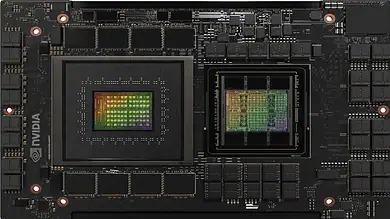
The reason lies in the “Neural Processing Unit” (NPU) integrated into the Blackwell chips. DLSS 5 requires a specific type of FP8 precision and a new “Temporal Memory Buffer” that doesn’t exist on the RTX 40-Series. For those who recently upgraded to an RTX 4090, the news that their card is already “legacy hardware” for these features is a tough sell.
The Road Ahead: Fall 2026 and Beyond
NVIDIA has confirmed that DLSS 5 will launch alongside the RTX 5090 and 5080 in October 2026. Major engines like Unreal Engine 5.5 have already integrated the DLSS 5 plugin. What does this mean for the average gamer? It means we are entering an era where “Native Resolution” is a dead concept. We will only care about the quality of the “Neural Dream” the GPU is projecting onto our screens.
DLSS 5 is more than a performance booster; it is a fundamental rewrite of digital reality. Whether it preserves the artist’s vision or replaces it with a polished, AI-generated facsimile remains to be seen. But one thing is certain: the era of the “simulated pixel” is over, and the era of the “hallucinated pixel” has begun.