

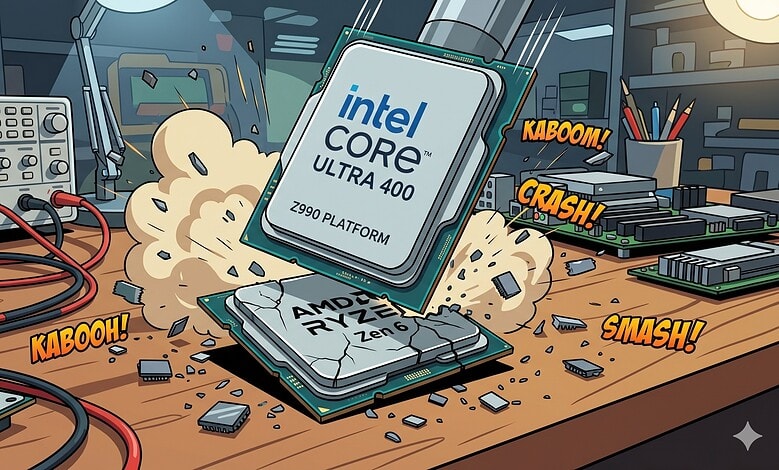
With its RYZEN release, in 2016 ( when dinosaurs were still roaming the face of the earth ), AMD had upset a near 2 decade long truth : INTEL leads and AMD follows.
Since then, AMD has consistently, out specced INTEL on every platform, and went from 15% to 75% market share in the PC computing world.
And 2026 is about to see the exact same normative upset as Intel has quietly planned its comeback and AMD seems to have missed generational train.
AMD X970E PCH, AKA X870E … AKA X670E
If you were hoping for a ground-up silicon redesign for the next generation of AM5 motherboards, the upcoming X970E chipset is rather a sidegrade than anything else. Leaks ahead of Computex 2026 indicate that AMD is recycling, yet again its tried-and-true Promontory 21 (PROM21) dual-chip layout—the exact same silicon powering the current X870E and X670E boards. Yeah (not).
Chipset Comparison: X870E vs. X970E
| Feature | AMD X870E (Current) | AMD X970E (Upcoming) |
| Silicon Architecture | Dual Promontory 21 (PROM21) | Dual Promontory 21 (PROM21) |
| CPU-to-Chipset Link | PCIe 4.0 x4 (16 GB/s) | PCIe 4.0 x4 (16 GB/s) |
| Downstream PCIe Lanes (PCH) | Up to 12 usable (mix of PCIe 4.0 & 3.0) | Up to 12 usable (mix of PCIe 4.0 & 3.0) |
| USB Support | 2x USB4 (40Gbps), up to 2x 20Gbps, 10x 10Gbps | 2x USB4 (40Gbps), enhanced signal integrity for 20Gbps |
| Wi-Fi Standard | Wi-Fi 7 (via discrete M.2 module) | Wi-Fi 7 (Optimized Multi-Link Operation) |
| Native Memory Support | Standard UDIMM DDR5 | Native CUDIMM & CAMM2 DDR5 |
| Memory Speeds | ~6000-8000 MT/s | 8000+ MT/s (Targeting 9000+ MT/s) |
| Primary Upgrades | USB4 standard, PCIe 5.0 expansion | Advanced trace routing, EXPO 1.2 |
Because the underlying hardware remains unchanged, the uplink to the CPU will remain PCIe 4.0 x4 (half of what Intel will feature) which I think is a BIG mistake ( among others ) . Instead of doing anything innovative, AMD is betting everything and anything next-generation memory.
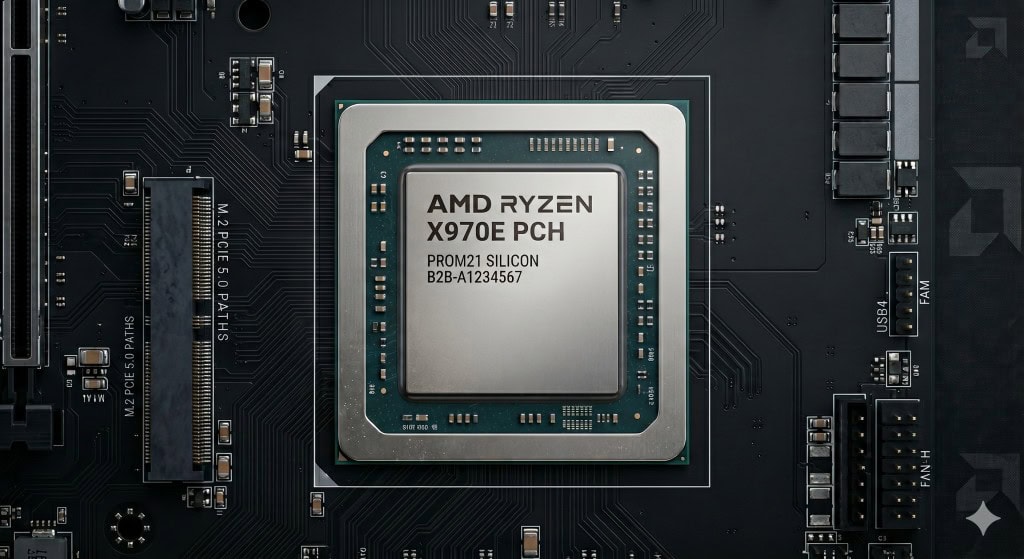
X970E boards are being built from the ground up to provide native, high-speed support for CUDIMM and CAMM2 DDR5 standards. While current Ryzen 9000 processors can only run CUDIMMs in a limited “bypass mode” due to their internal memory controller constraints, X970E platforms are laying the physical groundwork to push well beyond the 8000 MT/s barrier. Paired with the upcoming EXPO 1.2 standard, this chipset is heavily focused on signal integrity and extreme memory overclocking rather than expanding the total PCIe lane count.
And that’s great, but not enough to generate excitement and to faces the overall PCIe 5.0 explosion intel Z990 powered motherboards will see. Unlike Intel Z990 PCH which will feature natively 12 PCIe 5.0 lanes, AMD’s choice to keep the now legacy PROMOD21 chips, makes that platform irrelevant on arrival. What a shame.
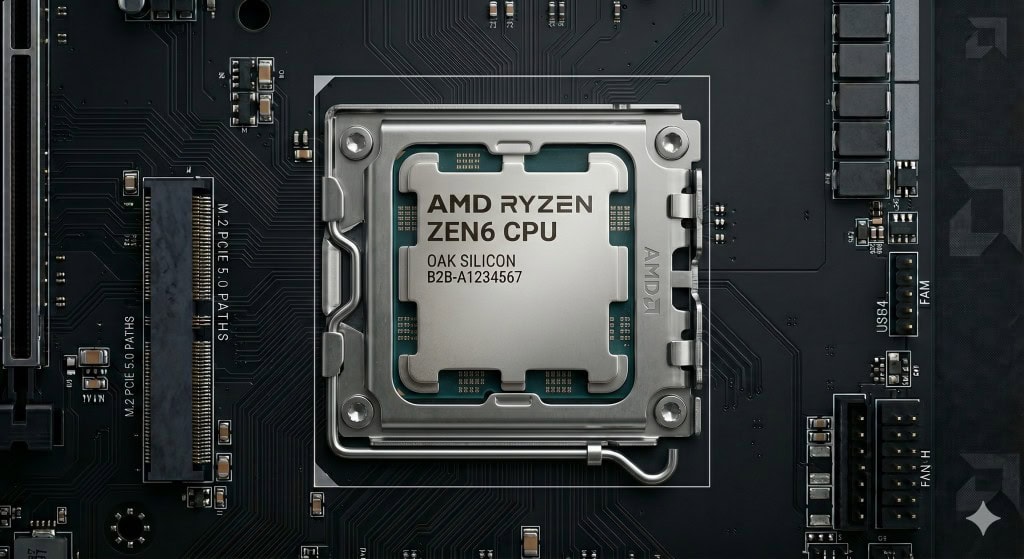
Betting everything on Ryzen “Zen 6” CPUs instead… and still missing the mark.
Clearly AMD’s strategy was to place everything on the CPU shoulders, betting heavily on a TSMC 2nm lithography. And if you look at the table below, you can see a very similar picture we have seen for its X970E chipset.
Desktop CPU Comparison: Zen 5 vs. Zen 6
| Specification | Ryzen 9000 Series (Zen 5) | Ryzen 10000 Series “Olympic Ridge” (Zen 6) |
| Lithography (CCD) | TSMC 4nm (N4P) | TSMC 2nm (N2 Nanosheet) |
| Lithography (IOD) | TSMC 6nm | TSMC 4nm or 3nm |
| Max Core Count | 16 Cores (2x 8-core CCDs) | 24 Cores (2x 12-core CCDs) |
| Max Boost Clocks | Up to 5.7 GHz | 6.3 GHz – 6.4 GHz (Projected) |
| L3 Cache (Per CCD) | 32 MB | 48 MB (Up to 144 MB on X3D models) |
| Total CPU PCIe Lanes | 28 Total PCIe 5.0 (24 usable) | 28 Total PCIe 5.0 (Potentially PCIe 6.0 ready) |
| PCIe Bandwidth | PCIe 5.0 | PCIe 5.0 (with Gen 6 readiness for future platforms) |
We got more cores, more transistor density, more cash memory and all that is great BUT we have the same amount of PCIe 5.0 lanes completely missing the bandwidth upgrade which would mature the PCIe 5.0 standard.
Intel is about to murder AMD in the desktop world.
If we look at the late-2026 release window, we are staring down what could be the biggest upset in the DIY PC space in over a decade. For the first time since the original Ryzen launch, Intel is perfectly positioned to catch AMD flat-footed and completely take over the spec war.
| Feature | AMD X970E + Zen 6 (24-Core) | Intel Z990 + Core Ultra 400 (52-Core) |
| Max CPU Cores | 24 Cores (All standard Zen 6) | 52 Cores (16 P-Core, 32 E-Core, 4 LP) |
| CPU-to-Chipset Link | PCIe 4.0 x4 (8 GB/s) | DMI 5.0 x4 (16 GB/s) |
| PCIe 5.0 Lanes (CPU) | 24 usable | 24 usable |
| PCIe 5.0 Lanes (Chipset) | 0 | 12 |
| Total Usable PCIe 5.0 | 24 Lanes | 36 Lanes |
| Additional Legacy Lanes | ~12 (Mix of PCIe 4.0 / 3.0) | 12 (All PCIe 4.0) |
| USB4 / Thunderbolt | 2x USB4 (40 Gbps) | 2x USB4 / Thunderbolt 4 (40 Gbps) |
| Standard USB (Max) | 2x 20 Gbps, 10x 10 Gbps | 5x 20 Gbps, 10x 10 Gbps, 10x 5 Gbps |
| Wi-Fi Standard | Wi-Fi 7 | Wi-Fi 7 |
Without going in endless specs commenting, I think the table above speaks for itself. Intel is outspeccing about everything aspect of the incoming AMD platform, and will probably to go-to choice in terms of computing in the next 2 to 3 years.
AMD has missed its 2026-2027 season before it started, and will probably bet everything on PCIe 6.0 and DDR6 standards to recover in late 2027. But, I can bet you a hot pizza nad cold brew, 2027 will be a dark year for AMDs standing in the computing industry.


Great write-up as always Laurent! You’ve painted a pretty bleak picture for AMD, and if we’re just staring at the spec sheets, the numbers really don’t lie.
But honestly, if you look at what it actually takes to build a PC right now, especially if you’re thinking late 2026 or 2027, the costs just flip the script on all those specs:
The RAM price Wall: You talked about how AMD is all-in on the X970E and shooting for memory speeds over 9000 MT/s. The thing is, with DDR5 prices going wild because of enterprise AI, who’s actually buying those high-end CUDIMM or CAMM2 kits? Most of us, regular builders, are just going to stick with the 5600 or 6000Mhz range because it’s affordable. Why drop a small fortune on exotic RAM just to get the main perk out of a chipset that’s getting recycled anyway?
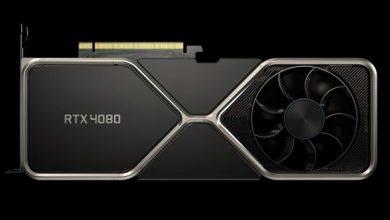
The GPU price explosion: RAM isn’t the only problem. GPUs are just absurdly expensive now. When even a decent graphics card chews up 70% of your whole build budget, Intel’s huge 36 PCIe lane edge for running multiple GPUs or loading up on NVMe drives really just becomes some theoretical advantage for almost everyone. I can’t afford a 32GB VRAM GPU, so thinking about a second one? In that sense, maybe AMD reusing PROM21 silicon is a blessing in disguise since it should keep motherboard prices within reason, saving us money for the GPU, where we really need it.
Power vs. Efficiency: Intel throws a bunch of “freebies” on paper, but what will it take to power and cool a 52-core beast? On the other hand, AMD’s 2nm node should (hopefully) mean better efficiency.
So, let’s say you’re a practical builder right now, trying to set up a solid rig for productivity, local AI and gaming without selling a kidney, how would you make these choices? Does AMD’s platform turn into a bad deal since you need overpriced RAM to really take advantage of it, or is Intel just overloading the spec sheet with stuff most of us won’t actually be able to afford by 2027?
Would love to hear how you see this ! Keep up the great work !