For over a decade, the “Gaming King” title was a heavy crown that lived almost exclusively in the Intel camp. Intel relied on raw clock speed and high power envelopes to stay ahead. However, by the spring of 2026, the launch of the AMD Ryzen 9000X3D series—spearheaded by the monstrous Ryzen 9 9950X3D2—marks the most aggressive move in history to dethrone “Team Blue” once and for all.
What Makes the 9950X3D2 Special?
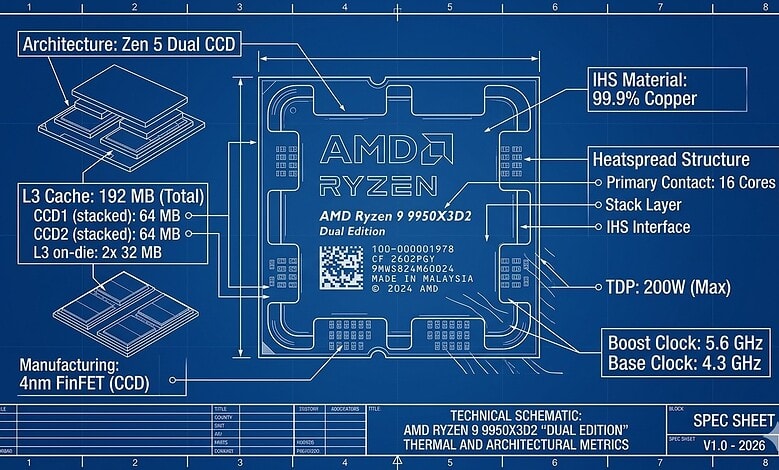
The secret weapon in this generation is the 2nd Generation 3D V-Cache. In previous years, the cache was stacked on top of the CPU cores, creating a thermal “blanket” that forced AMD to lower clock speeds. With the 9000X3D series, AMD “flipped the script.” The 3D V-Cache is now positioned underneath the Core Complex Die (CCD). This allows the heat-generating cores to sit directly against the cooler, allowing the Ryzen 9 9950X3D2 to maintain a massive 5.6 GHz boost clock while carrying a staggering 192 MB of L3 cache.
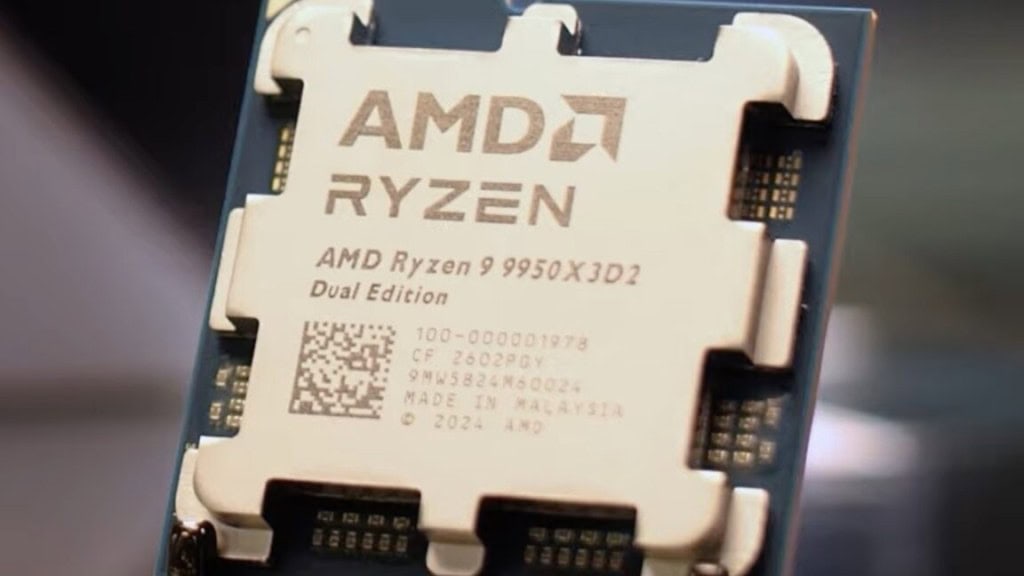
AMD isn’t just trying to compete; they are rendering Intel’s frequency advantage irrelevant by eliminating the “memory wall.” By providing a total pool of 208 MB of cache, AMD ensures the CPU almost never has to wait for slower system RAM, a bottleneck that has historically allowed Intel’s high-frequency chips to maintain a lead.
Technical Specifications & Global Pricing (MSRP)
| Specification | 9800X3D | 9850X3D | 9900X3D | 9950X3D | 9950X3D2 |
| Release Date | Nov 7, 2024 | Jan 29, 2026 | Mar 12, 2025 | Mar 12, 2025 | April 22, 2026 |
| Cores / Threads | 8 / 16 | 8 / 16 | 12 / 24 | 16 / 32 | 16 / 32 |
| Total L3 Cache | 96 MB | 96 MB | 128 MB | 128 MB | 192 MB |
| Boost Freq. | 5.2 GHz | 5.6 GHz | 5.5 GHz | 5.7 GHz | 5.6 GHz |
| TDP | 120 W | 120 W | 120 W | 170 W | 200 W |
| MSRP (USA) | $479 | $499 | $599 | $699 | $799 (Est.) |
| MSRP (EU) | ~529 € | ~549 € | ~689 € | ~829 € | ~949 € (Est.) |
1. Gaming Performance: The New Benchmark
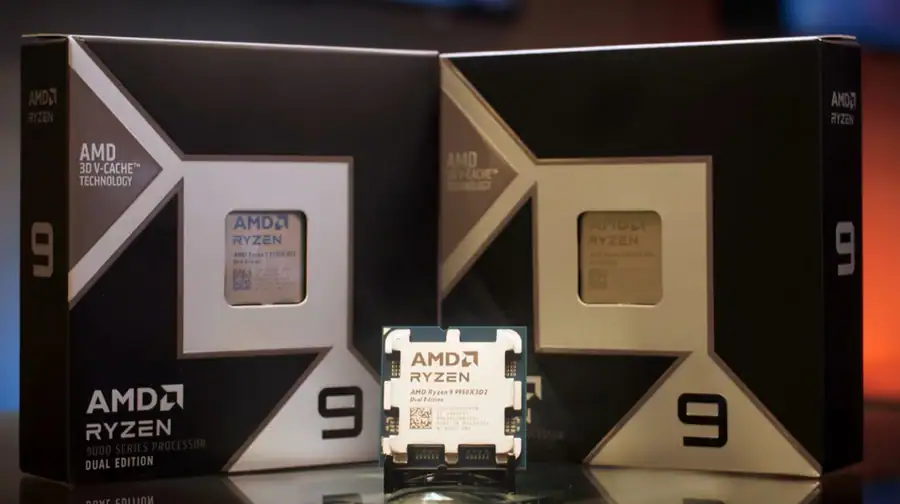
In the gaming arena, the Ryzen 9 9950X3D2 is the first consumer CPU to feature 3D V-Cache on both 8-core dies. This “Dual Edition” design eliminates the scheduling complexities seen in previous hybrid chips, ensuring every core has elite-tier latency.
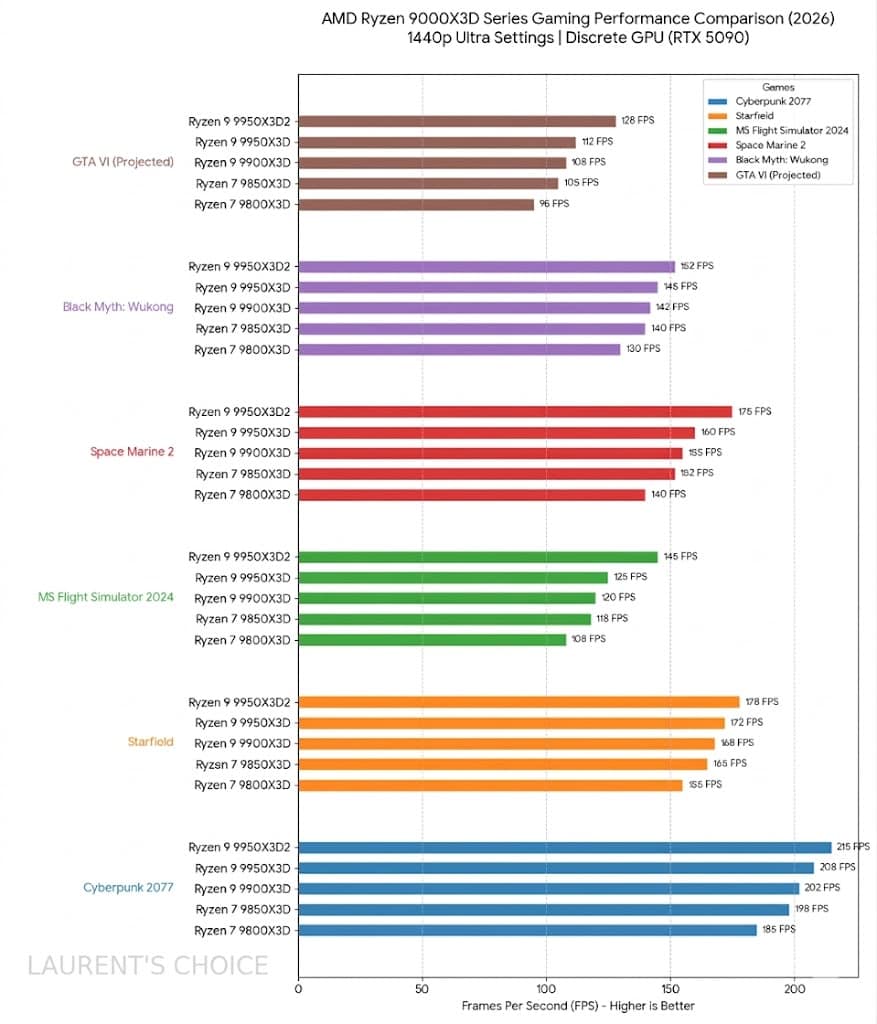
As seen in the technical blueprint below, the 9950X3D2 delivers a “knockout blow” in titles like MS Flight Simulator 2024, where it hits 145 FPS, and the upcoming GTA VI, where it reaches a projected 128 FPS. It effectively removes the 1% low stutters that plague even the fastest Intel Core Ultra 200S processors.
2. Production Performance: A Titan for Creators
The “Dual Edition” isn’t just a gaming specialist. For years, X3D chips were seen as “gaming only” due to lower multi-threaded performance. The Ryzen 9 9950X3D2 shatters that myth. By providing symmetric cache across all 16 cores, it significantly accelerates data-heavy professional workflows.
Rendering & Content Creation
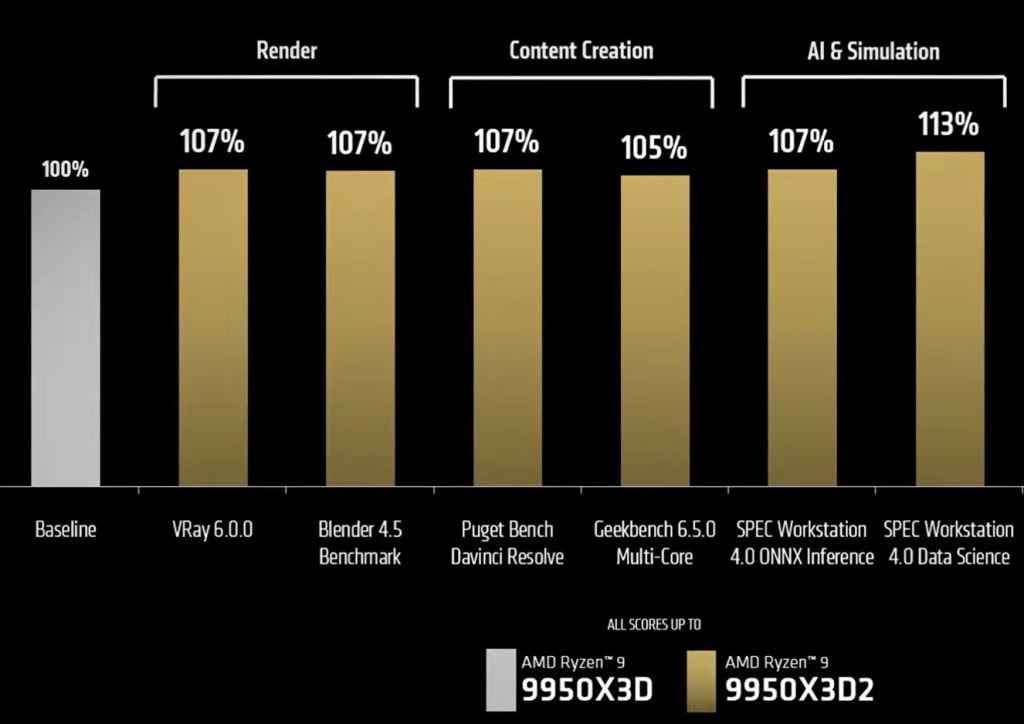
In tools like Blender 4.5 and V-Ray 6.0, the 9950X3D2 provides a 107% performance baseline compared to the standard 9950X3D. The massive cache allows the CPU to keep more geometry and texture data on-chip, reducing the time spent waiting for memory cycles. For video editors in DaVinci Resolve, the uplift is a consistent 107%, ensuring buttery-smooth 8K timeline scrubbing.
AI & Data Science
Perhaps the most surprising gain is in AI and Simulation. In SPEC Workstation 4.0 Data Science benchmarks, the 9950X3D2 sees its largest jump at 113%. Large language models (LLMs) and complex neural network inferences benefit immensely from the 192 MB L3 pool, allowing researchers to run more significant models locally without hitting the “DDR5 bandwidth wall.”
Summary of Productivity Uplift
-
Render (V-Ray/Blender): +7% vs. standard 9950X3D.
-
Content Creation (DaVinci/Geekbench): +5-7% improvement.
-
AI & Simulation (SPEC/ONNX): +7-13% performance gain.
Conclusion: The New Era of No Compromise
AMD’s transition to the “Under-Die” cache architecture has finally created the “Holy Grail” of silicon: a processor that is the undisputed king of gaming without sacrificing a single watt of professional productivity.
By offering the 9850X3D as a high-frequency gaming specialist and the 9950X3D2 as a dual-cache productivity monster, AMD has effectively cornered Intel. Intel’s Arrow Lake and upcoming Nova Lake architectures are focusing heavily on “Performance-per-Watt” and AI NPUs, which are great for mobile and general use, but they are struggling to keep up with the sheer gaming throughput of AMD’s SRAM-heavy design.
For the first time in nearly two decades, the question isn’t “Should I buy Intel or AMD for gaming?” but rather “Which X3D chip fits my budget?” AMD has built a fortress around the high-end gaming market, and with the Ryzen 9 9950X3D2 delivering 215 FPS in Cyberpunk 2077, the “Gaming King” title seems safely tucked away in the “Red Team’s” vault.