
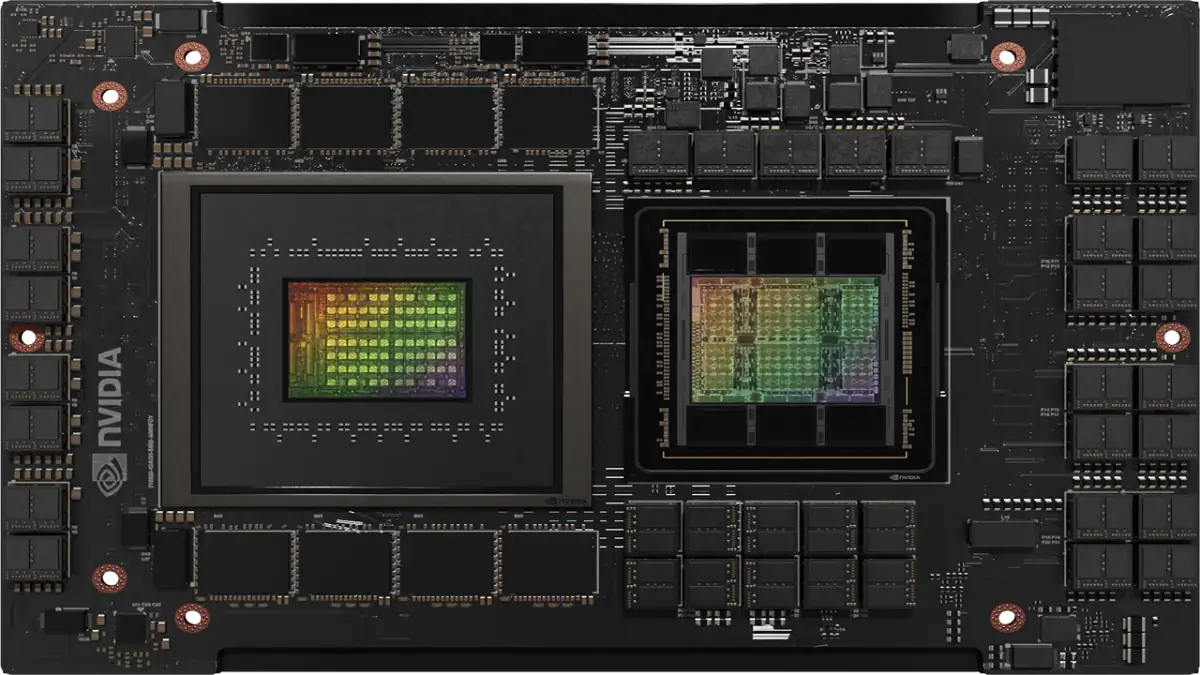
NVIDIA has partnered with MEDIATEK to produce an all purpose CPU able to compete against Intel and AMD on the mobility market.
The first step towards what could very well be the biggest upset in recent PC Gaming and AI purposed PCs in a decade.
The N1X
The NVIDIA N1X is a highly integrated System-on-Chip (SoC) designed to shatter the traditional boundaries between thin-and-light laptops and high-performance workstations. Co-developed with MediaTek, the N1X bypasses the traditional x86 architecture entirely in favor of an Arm-based design, integrating the CPU, a massive GPU, and the Neural Processing Unit (NPU) onto a single package. Recently, NVIDIA CEO Jensen Huang confirmed the existence of this silicon, stating it is purpose-built for “AI computers” and emphasizing its unique blend of low power consumption and high-end performance—making it a true “PC-class” platform rather than a recycled mobile phone chip. Physically, the N1X features a bare-silicon, dual-dielet design (one tile for the MediaTek CPU, one for the NVIDIA GPU) surrounded by integrated memory rings and permanently soldered to the motherboard via a Ball Grid Array (BGA).
| Feature | NVIDIA N1X Specifications |
| Architecture | ARMv8 (CPU) + Blackwell (GPU) |
| Lithography | TSMC 3nm Process |
| RAM | upto 128 GB LPDDR5x (Unified Memory) |
| Native RAM Speed | Up to 8533 MT/s |
| Memory Bus / Channels | 256-bit / Quad-Channel equivalent |
| Target Wattage (TDP) | 120W – 140W (Laptops), up to 170W (Mini PC) |
| PCIe Availability | x12 PCIe Gen 5.0 (Limited lanes due to high integration) |
| Socket Type | BGA (Soldered directly to the board) |
The MediaTek CPU Engine
The computational heart of the N1X is a massive 20-core Arm CPU, heavily engineered by MediaTek. It utilizes a “big.LITTLE” configuration split perfectly down the middle. The Performance Cores (P-Cores) consist of 10 Cortex-X925 units, projected to hit boost frequencies around 4.0 GHz to 4.2 GHz. These are tasked with heavy lifting, including the demanding real-time emulation of legacy x86 Windows software. The Efficiency Cores (E-Cores) consist of 10 Cortex-A725 units running at lower clock speeds to handle background tasks and maximize battery efficiency. Both core clusters share a massive pool of localized L3 cache to quickly feed data to the graphics block. Compared to current x86 competitors like the Intel Core Ultra 200S series or AMD’s Ryzen AI Max, the N1X CPU trades slightly lower raw single-thread speeds for massive multi-threaded efficiency, delivering desktop-class core counts at a fraction of the thermal output.
The Blackwell iGPU
What truly separates the N1X from Apple Silicon or Qualcomm’s Snapdragon X Elite is the integrated GPU. Built on NVIDIA’s cutting-edge Blackwell architecture, this graphics block features 48 Streaming Multiprocessors (SMs), translating to a staggering 6,144 CUDA cores—the exact same core count as a desktop RTX 5070. It is equipped with 192 Tensor cores to power DLSS 5 (NVIDIA’s real-time neural rendering and upscaling tech) and relies on a unified memory architecture, meaning it dynamically shares the ultra-fast LPDDR5x RAM pool with the CPU rather than having dedicated VRAM. Because it is constrained by a strict laptop thermal limit, the GPU frequency will likely be capped around 1.5 GHz to 1.8 GHz, preventing it from drawing the 200W+ required to match a desktop card, but still offering unprecedented graphical power for an integrated chip.

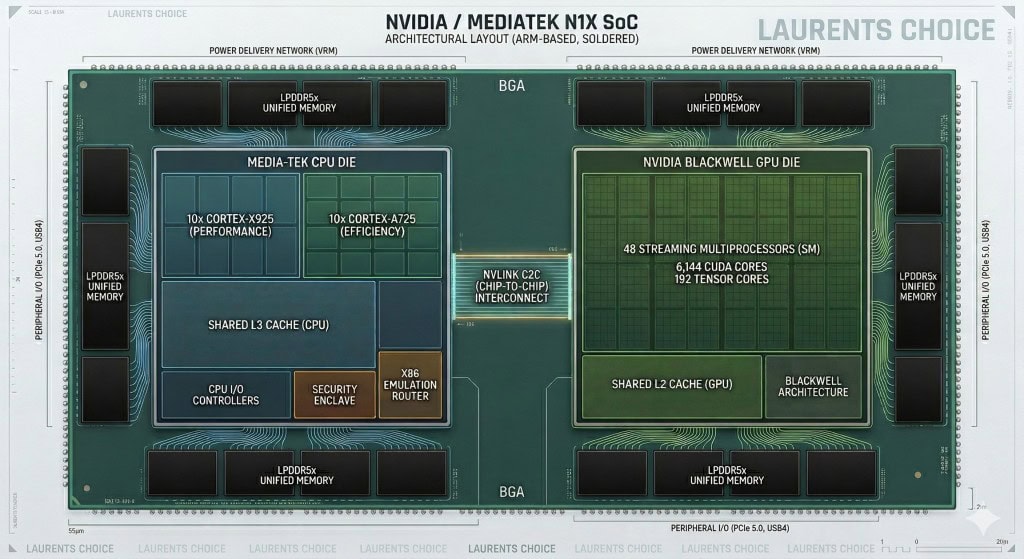
NVIDIA N1X SoC Core Breakdown
| Core Type | Architecture | Core Count | Maximum Frequency | Threads / AI Performance |
| CPU Performance Cores | Arm Cortex-X925 | 10 | Up to ~4.0 GHz | 10 Threads (1 per core) |
| CPU Efficiency Cores | Arm Cortex-A725 | 10 | Up to ~3.0 GHz* | 10 Threads (1 per core) |
| GPU Compute Cores | NVIDIA Blackwell (CUDA) | 6,144 (48 SMs) | Up to ~2.54 GHz* | N/A (Equivalent to desktop RTX 5070) |
| AI / Neural Cores | NVIDIA Tensor Cores | 192 | Up to ~2.54 GHz* | ~1,000 TOPS (FP4/NVFP4) |
A note on frequencies: While the Blackwell architecture is technically capable of hitting 2.54 GHz, the N1X is bound by a strict 120W to 140W total power limit for the entire chip (CPU, GPU, and memory combined). In real-world scenarios, especially during heavy gaming, the system will dynamically throttle these maximum frequencies down to prevent the laptop or mini-PC from overheating.
Performance Expectations
CPU Performance Overview
While the N1X relies heavily on a translation layer for older Windows software, raw compute tasks optimized for Arm64 run natively and showcase the sheer power of the MediaTek-designed 20-core array. Early leaked engineering sample benchmarks (such as Geekbench 6) demonstrate that the N1X is highly competitive against flagship x86 laptop processors and even some desktop parts. Its multi-threaded scaling is exceptional due to the 10 Cortex-X925 high-performance cores.
Projected CPU Multi-Core Performance (Geekbench 6)
======================================================================
Apple M3 Max (16-Core)       | ████████████████████████████████ 21,200
NVIDIA N1X (20-Core Arm)     | ████████████████████████████ 18,800
Intel Core Ultra 9 285K      | ███████████████████████████ 18,100
AMD Ryzen AI Max             | █████████████████████████ 17,400
Qualcomm Snapdragon X Elite  | █████████████████████ 15,200
Section 2: Gaming Performance Overview
Gaming is where the N1X forces a paradigm shift. Even factoring in the “emulation tax”—the performance lost when Windows translates x86 game code to Arm on the fly—the brute force of 6,144 Blackwell CUDA cores and DLSS 5 frame generation pushes the N1X far beyond any existing integrated graphics. It comfortably rivals dedicated mid-range laptop GPUs.
Projected Gaming Performance: Cyberpunk 2077 (1440p High) - FPS
======================================================================
RTX 4070 Laptop (Dedicated)  | ████████████████████████████████ 95 FPS
NVIDIA N1X (Emulated x86)    | ██████████████████████████ 82 FPS
Apple M3 Max (Translated)    | ██████████████ 45 FPS
AMD Radeon 890M (Native iGPU)| ██████████ 32 FPS
Intel Arc Graphics (Native)  | ████████ 28 FPS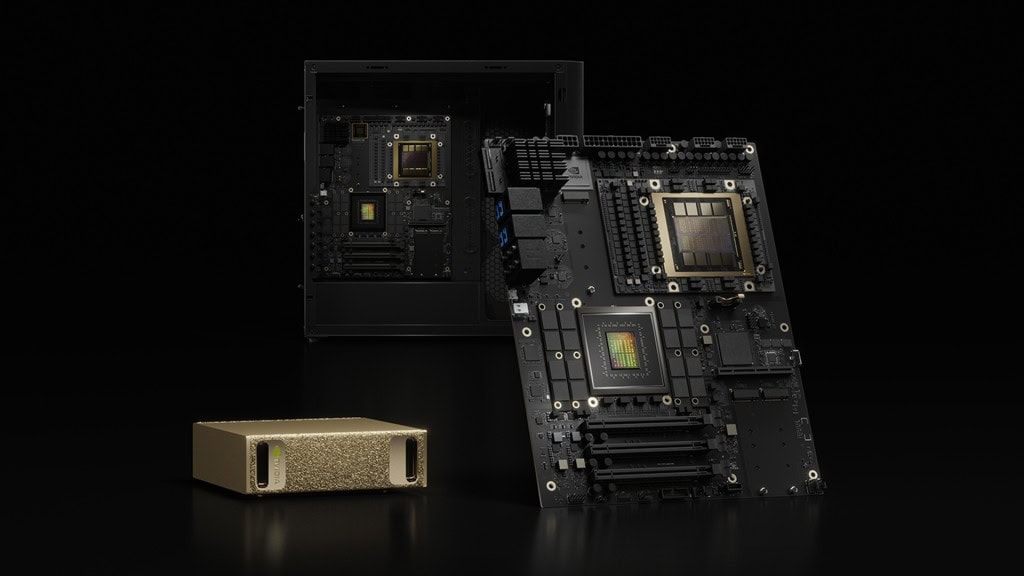

AI : 1000 TOPS
While traditional x86 processors from Intel and AMD rely on dedicated, low-power NPUs (Neural Processing Units) capping out around 50 to 55 TOPS for light background tasks, NVIDIA takes a radically different approach. By leveraging the 192 Tensor Cores embedded inside the massive Blackwell GPU, the N1X delivers an astonishing ~1,000 TOPS. This effectively turns a thin-and-light laptop into a localized AI server capable of handling heavy-duty, instantaneous generative workloads.
| Processor / SoC | Architecture Family | AI Hardware Type | Dedicated AI Speed | Total Platform Speed |
| NVIDIA / MediaTek N1X | Arm + Blackwell |
192 Tensor Cores |
~1,000 TOPS | ~1,000+ TOPS |
| Intel Core Ultra X9 388H | Panther Lake (Series 3) |
Intel NPU 5 |
50 TOPS | Up to 180 TOPS |
| AMD Ryzen AI 9 HX PRO 375 | Strix Point (PRO) |
AMD XDNA 2 |
55 TOPS | ~85 TOPS |
| AMD Ryzen AI Max+ 395 | Strix Halo |
AMD XDNA 2 |
50 TOPS | ~126 TOPS |
Here is how that massive computational headroom translates to real-world use:
1. Autonomous AI Agents and OpenClaw Running advanced, autonomous AI agents like OpenClaw is exactly the type of workload the N1X was built to dominate. OpenClaw is an open-source AI agent that lives on your local machine, connects to messaging apps, and can autonomously execute shell commands, manage calendars, and build code on your behalf.
-
Millisecond Response Times: With the N1X’s ~1,000 TOPS and unified LPDDR5x memory, you can run massive open-weight LLMs (like a 70-billion parameter model) locally to act as the “brain” for these agents, allowing them to think and reply instantly.
-
True 24/7 Autonomy on Battery: The ultra-efficient MediaTek Cortex-A725 “Efficiency Cores” can keep OpenClaw’s gateway listening in the background 24/7 without draining the laptop’s battery. When you give it a complex task, the SoC instantly wakes the massive GPU tile, crunches the AI math, and immediately goes back to sleep.
-
Total Privacy: Because OpenClaw requires deep system access to read private files and terminal commands, the N1X allows your agent to process all sensitive data entirely on-device, ensuring zero data exfiltration to corporate cloud servers.
2. Running Local Large Language Models (LLMs) Currently, most people rely on cloud services for advanced AI, which requires an internet connection. Because the N1X uses a “unified memory” architecture—meaning the GPU has direct access to high-speed system RAM rather than being limited by a small VRAM pool—developers can run complex coding assistants, document summarizers, and custom chatbots entirely offline.
3. Next-Generation Gaming (DLSS 5 and NVIDIA ACE) The AI hardware on the N1X isn’t just for productivity; it is the backbone of its gaming performance.
-
DLSS 5 (Neural Rendering): Instead of just upscaling pixels, the Tensor cores use AI to generate entire high-quality frames and predict complex lighting, allowing this mobile chip to output graphics that would normally require a massive desktop power supply.
-
NVIDIA ACE (Avatar Cloud Engine): The N1X has the local processing power to run real-time conversational AI for non-playable characters (NPCs). You can speak into your microphone, and the AI will generate a unique, voice-acted response from the NPC on the fly, complete with synced facial animations.
4. Accelerated Content Creation & Copilot+ For video editors and 3D artists, tasks that used to take hours on a CPU—like rotoscoping, generating missing frames for slow-motion, or generating local text-to-image assets via Stable Diffusion—are handled instantly by the Tensor cores. Furthermore, it easily powers Microsoft’s deeply integrated “Copilot+” ecosystem. Features like real-time live captions, visual timeline searches, and advanced studio camera effects can all run simultaneously without the laptop fans ever needing to spin up.
Use Cases and Market Rollout
Intended Use and Efficiency
The N1X is engineered primarily for premium laptops, mobile workstations, and Mini PCs (like the rumored consumer variant of the DGX Spark). By combining the CPU and a massive GPU onto a single die with unified memory, manufacturers can build incredibly thin laptops that don’t require the complex, bulky cooling systems normally needed for a separate dedicated graphics card. Despite housing a 120W to 140W TDP ceiling for heavy workloads, the Arm architecture’s aggressive power-gating means the chip sips electricity during basic tasks. Under light use (web browsing, video playback), the theoretical battery life span of an N1X-powered laptop is projected to comfortably hit the 15 to 20+ hour mark, rivaling Apple’s MacBooks while retaining full gaming capabilities.
Availability and Pricing
The N1X ecosystem is on the verge of its official consumer rollout. Following its expected formal unveiling in the first quarter of 2026 (likely surrounding GTC 2026), the chip will hit the market in the first half of 2026. Major PC manufacturers are already on board; leaked shipping manifests and support pages have confirmed that Dell is testing the N1X in its XPS and upcoming Alienware lines, while Lenovo is integrating it into their Legion and Yoga Pro models. Because the N1X requires highly integrated, premium LPDDR5x memory—which is currently facing high costs due to global AI demands—these devices will be positioned strictly in the premium tier. Consumers should expect N1X laptops and Mini PCs to carry enthusiast-level pricing, likely starting around the $1,500 to $2,000 mark upon release.