

Intel “Nova Lake-S” Samples Hit Motherboard Labs: The Dawn of Core Ultra 400 and LGA1954
This week marks a critical milestone for the enthusiast PC hardware market: Intel has officially begun shipping engineering samples of its upcoming Core Ultra 400 series CPUs—codenamed “Nova Lake-S”—to tier-one motherboard manufacturers. This handover kicks off a rigorous hardware validation and BIOS tuning phase for the next-generation 900-series chipset ecosystem, specifically focusing on the high-end Z990 platform.
The LGA1954 Transition and Power Delivery
With Nova Lake-S comes the introduction of the brand-new LGA1954 socket. For motherboard engineering teams, the immediate priority is stress-testing massive power delivery systems. Intel’s new architectural approach packs a staggering amount of silicon, with flagship configurations expected to reach up to 52 cores—combining 16 “Coyote Cove” P-Cores, 32 “Arctic Wolf” E-Cores, and 4 LP-Cores.
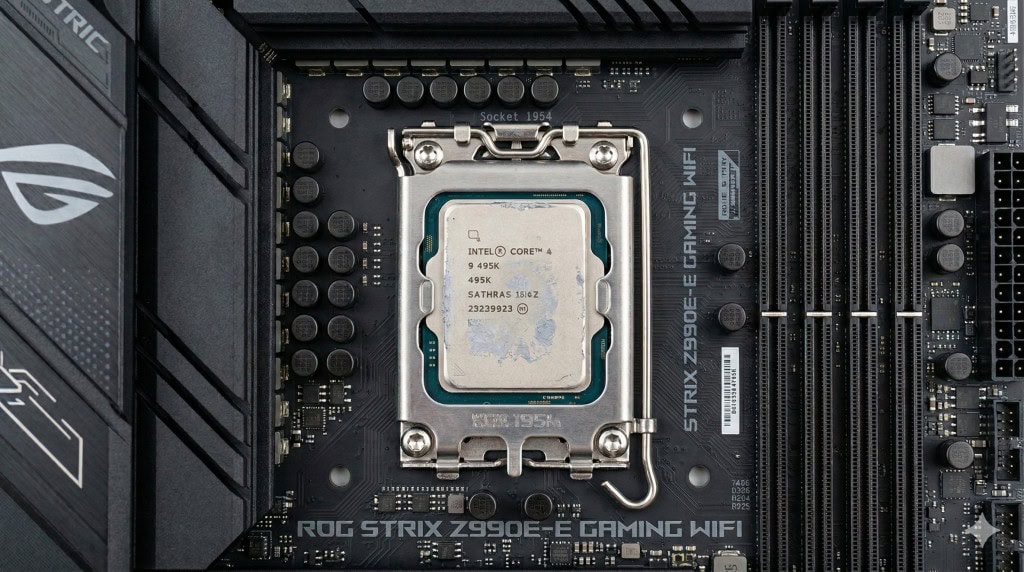

More importantly, the top-tier Core Ultra 400DX variants are pushing the thermal design power (TDP) ceiling up to 175W. To accommodate these extreme transient loads, vendors are heavily scrutinizing their VRM layouts. We can expect enthusiast Z990 boards to feature incredibly robust, over-engineered power stages, optimized to deliver clean, sustained voltage without thermal throttling under heavy multi-threaded workloads.
| Feature | Core Ultra 200 (Arrow Lake-S) | Core Ultra 400 (Nova Lake-S) |
| Architecture (P-Core / E-Core) | Lion Cove / Skymont | Coyote Cove / Arctic Wolf |
| Socket | LGA1851 | LGA1954 |
| Maximum Cores | 24 (8P + 16E) | 52 (16P + 32E + 4LPE) |
| Maximum Cache | 36 MB L3 | Up to 288 MB bLLC |
| CPU PCIe 5.0 Lanes | 20 Lanes | 24 Lanes |
| Maximum TDP Class | 125 W | 175 W |
Tackling the Cache Deficit: Enter bLLC
A major focus of this testing phase involves Intel’s aggressive new hardware strategy to directly combat AMD’s Ryzen X3D dominance in gaming. The new Core Ultra 400D and dual-tile 400DX SKUs integrate Intel’s “big Last Level Cache” (bLLC) technology.
The 400DX samples currently hitting test benches boast an unprecedented 288 MB of total cache. Motherboard engineers are now working directly with Intel to refine BIOS microcode, ensuring optimal thread scheduling and minimizing latency across this massive cache pool.
Pushing Next-Gen Memory Architectures
Beyond VRM thermal management, memory topology is the primary battlefield for these new motherboards. The Core Ultra 400 series and Z990 chipsets are designed to push the absolute limits of DDR5 bandwidth.
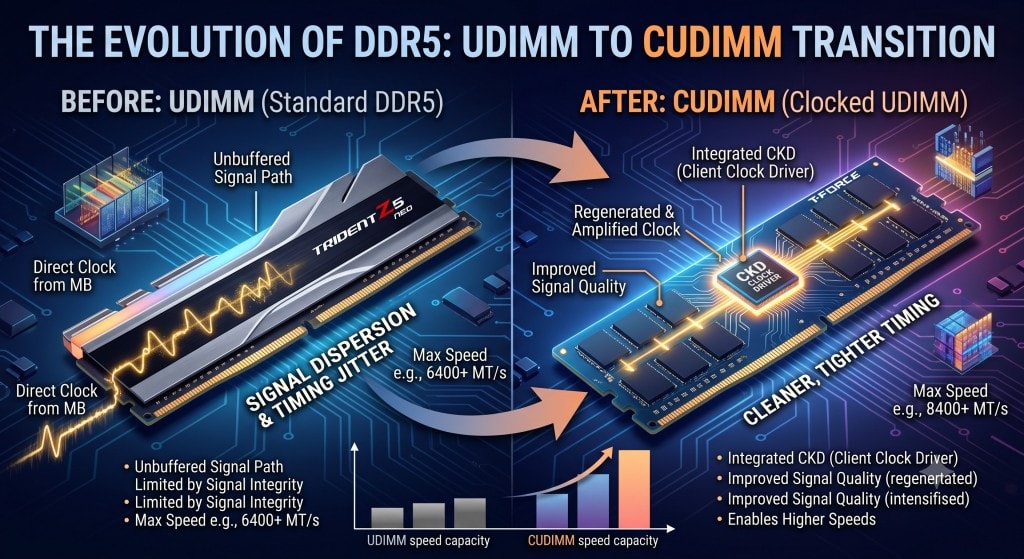
Manufacturers are strictly refining motherboard trace layouts to guarantee maximum signal integrity for emerging memory architectures, particularly to support the high speeds of the CUDIMM standard. Ensuring stable, high-frequency memory overclocks with dense kits will separate the premium enthusiast boards from the rest of the pack.
| Feature | UDIMM (Standard DDR5) | CUDIMM (Clocked DDR5) |
| Clock Routing | Driven directly by the CPU’s memory controller | Regenerated locally on the memory module |
| Key Component | Standard PMIC and memory modules | Adds a CKD (Client Clock Driver) chip |
| Signal Integrity | Degrades as frequency scales higher | Cleaned and stabilized by the CKD chip |
| Stable Frequencies | Caps out around 7200 to 8000 MT/s | Scales from 8000 MT/s to well over 10,000 MT/s |
| Platform Era | All DDR5 motherboards (Z690, Z790, etc.) | Optimized for Z890, Z990, and X870E platforms |

As these Core Ultra 400 samples are pushed to their breaking points in testing labs globally, the next few months will dictate the stability and success of the LGA1954 launch. If vendors can master the intense power and memory demands of Nova Lake-S, the desktop market is in for a monumental generational leap.